

Kansas makes the cut

I recently had the opportunity to take a look at the Kansas state voter rolls. After some initial difficulty related to a technical defect in the files, I was able to run a few tests. The results tell me that Kansas has the cleanest voter rolls of all the states I’ve looked at so far: NY, NJ, OH, TX, PA, WI, AZ, GA, FL, CA, OK, HI, NC, and now, KS.
I have 2 primary measures: clones and algorithms. Secondarily, I look for other problems, like date mismatches where the person is registered to vote before they are born, or their birthdate is thousands of years in the future. How far I go to find problems has a lot to do with what I find in the big picture tests. NY and WI had amazing levels of errors throughout their databases, which kept me occupied for months. KS and OK are at the opposite end of the spectrum.
Algorithms
The type of algorithms I care about in voter rolls assign ID numbers or tag them in a way that creates a potential use as a covert data channel. New York has algorithms like that. So does NJ, WI, OH, TX, AZ, GA, and other states.
Checking to see if an algorithm is present is much easier than defining, solving, and extracting meaning from them. What I look for are ID numbers that are “out of place”. More specifically, out of place in a predictable way. Predictability comes from structure, and both allow hidden data to be embedded in the data.
Mapping algorithms are like a marriage advisor; they decide which numbers in any two fields are “married” to each other. These are usually state and county ID numbers, but there is some variation depending on the type of data available. A key to this is that both values must be unique in the database. One way to find these is to sort on one value, then study the other to see if it creates any well-structured patterns. Kansas didn’t have any fields that could be used this way, so the test was skipped.
Sequential number assignment is the standard best practice for assigning ID numbers. This method doesn’t have any security built into it, but no security method can protect anything in public records. This is because full names, addresses, and other information is unchanged, so manipulating the ID number is like expecting to disguise your car by getting a new radiator cap. Everything else is the same, so it doesn’t hide anything.
Kansas doesn’t have sequentially assigned ID numbers. This normally means an algorithm of some kind is in use. However, after numerous tests, I don’t see it. That doesn’t mean there isn’t one, but it failed all but one test that found them in other states. The test it passed, non-sequential numbering, isn’t enough to define an algorithm or characterize it as capable of carrying extractable data.
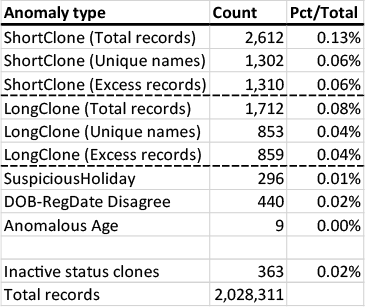
Where Kansas really shined was in the clone testing. Clones are illegal records from the moment they are created because they can be used to generate genuine ballots for fraudulent voting. Kansas had, at most, 1,310 of these, about 650 of which had to be simultaneously active. That is the lowest number by far in any state I’ve looked at. NY is over 1.5 million. Wisconsin is near a million. Even OK is about 5 times the KS number.
Kansas has a few hundred other problems that should be checked, one of which is quite striking: a registration date over 4,000 years in the future. Again, the numbers are small (3 future registrations).
The real issue I see with KS is that, while I am impressed by how much better their rolls are than every other state I’ve looked at, they would fail any normal business audit. 1,310 excess clone records is unacceptable in a commercial database. If there was only one, it would not only be a problem, but the moment it was found, it would be resolved, bringing the total to exactly zero.
The fact that any state is willing to tolerate clones in the numbers they do, particularly when many are simultaneously active, is a disgrace.
It is not sufficient to declare them innocent “clerical errors”. It doesn’t matter why they are there. They are illegal, should never have been made, and should be removed instantly upon discovery. To do otherwise is like leaving bullets in the body of a shooting victim and expecting him to recover, then shooting him again every year after that to test his lead tolerance.
In fields like banking and insurance, ID numbers are crucial to many types of fraud. Without them, fraudsters don’t have a place to put their stolen money, or a way to have it sent to themselves. The same is true in elections: fraudulent ID numbers are required to generate real ballots that can be slipped into ballot boxes, leaving no trace of their fraudulent origin.
Therefore, the standard must be changed. It is not acceptable, and never should have been, to tolerate any level of error in these rolls, particularly with ID numbers. Besides, it’s not like an accuracy mandate would require clerks to have genius level skills like Leonardo da Vinci or Albert Einstein. All they have to do is buy the same enterprise software used by other companies.
The irony is that the government does use the “good” software when it involves getting money to them, such as through Obamacare. They just don’t use it for elections. Kind of looks like there might be a reason for that.
After following your remarkable analysis for some time now, I have just come to a conclusion, while staring at the row of states' data you have looked at. You have been looking at databases which I now refuse to refer to as "Voter Rolls." Especially since I still send people to read your "The Bus Problem" 3 January 2024 post.
I was renewing my driver's license a couple of weeks ago at one of the "free enterprise" Dept. of Motor Vehicles "agencies(?)". The computer screen, tied to the state's database, announces to me that "You are registering to vote..." It is the First item! I told the "free enterprise" clerk that I was already registered to vote. He directed me to then answer "no" regarding whether I lived in the state or some other question to "skip" to the "next" section. The question was Not "Are you already registered to vote?" Why would I be inclined to view my "citizenship" of this specific community tied to my wanting to operate a motor vehicle in the state? But that's not all. You have all of these eager "party affiliated" people "authorized" to sign off on a person's voter registration form to be later turned into the county clerk's office. Really???
To vote for anything brought before a corporation's annual or special shareholders' meeting a list of Shareholders of Record at a specific date is generated. A "shareholder" is a member by owning a share of stock at that point in time. As you have shown "mist on the wind" can be "electronically" registered to vote. I don't think you Even need a whisp of mist. The electronic voter roll is merely a census pool made up/& not made up of stock (as in ie: cattle) to move dollars. I am so disgusted with electronics and the numb-minded clerks who process records.
Voter Rolls have become fantasy when you have "Senator" Adam Schiff's primary residence sitting in Maryland when he claims to be representing the people who live in California. Can we at least get some of those types of people arrested? Sigh.
Thank you for all the hard work and focus! You are "The Key."
Gaining Momentum in Pa, is the E-Polling Books. When voters arrived previously, they signed a paper book in ink and that was compared to a digital copy in the physical book.
Ebooks already have and know the signature. Bad Actors COULD conceivably inject voters into this ebook and use the digital signature to mask that a Voter In Person hadn't really shown up at the polls. Especially if their party is losing in the early morning hours.