

The Fishaphant

The New York Times has weighed in on the Bexar County anomalies. For the record, they made a few mistakes. After wading through their reporting, I came to the conclusion that the Times’ position is that the corrupted Bexar County early voting record I have analyzed comes down to a glitch. That is, an unspecified electronic feat of legerdemain.
I understand that we might be dealing with the same level of technical sophistication as Independence Day audience members, who did not question how an Apple laptop could hack into a space alien computer within five minutes and destroy it. For those who do not understand why the “glitch” hypothesis is just as silly, I will explain.
What a Glitch Is
There are several categories of glitch behavior. My list cannot be exhaustive, but should be enough to illustrate why glitch behavior, though seemingly erratic, follows its own rules — and why none of those rules produce what was found in Bexar County.
Independent Glitches
The type of glitch we most often hear about occurs independent of user action. It arises from some kind of physical or mechanical instability: a hard drive failure, an electrical surge, an electrical short. Each of these failure types can do any of the following three things to a file: delete or destroy it, modify it, or have no effect at all.
File modification is most likely when the file is in use at the moment the physical fault occurs, because the file is actively reading and writing to RAM or the hard disk. If that process is interrupted, file integrity can be lost. What do the corrupted files look like? One of the more frequent results is a file that is between 80% and 99% intact, with the remainder appearing as gibberish — like blacking out random words or letters in a book. The damage is random, affecting the ongoing write process at no specific time or place in the data. Another common type is truncation: the file is whole to a point, after which there is nothing.
In both cases, the defining characteristic is the same: the damage is uncontrolled. The glitch does not select. It does not plan. It does not calculate. It produces output that is degraded, truncated, or accidentally exposed — but never output that is more structured, more mathematically sophisticated, or more precisely engineered than what went in. Imagine a train crashing into a Ford Bronco. It doesn’t turn the Bronco into a Mazerati, it destroys the Bronco, leaving behind pieces that recognizably came from the Bronco. That is what physical damage does. It degrades what was there. It does not engineer something new from it.
Dependent Glitches
Dependent glitches can also be described as user error, or user activity combined with delicate software dependencies between application and operating system. I recently experienced one of these myself, on X of all places. I submitted a question and instead of receiving an answer, my screen began filling — endlessly — with what appeared to be raw training data in dozens of languages, including character sets I had never seen before. It looked like a waterfall of Wikipedia entries with no apparent connection to my question. When I ran it through an AI to analyze it, the answer came back that it was indeed training data — the inference pipeline had broken down and was leaking its source material rather than processing it into a coherent response.
This is what software failure actually looks like. The underlying data becomes visible in raw, unprocessed form. It is not meaningless — it is technically relevant to what was asked — but it is not doing anything purposeful. The structure it appears to have is inherited from its source, not generated by the malfunction itself. The malfunction simply removed the layer of processing that would have made it useful.
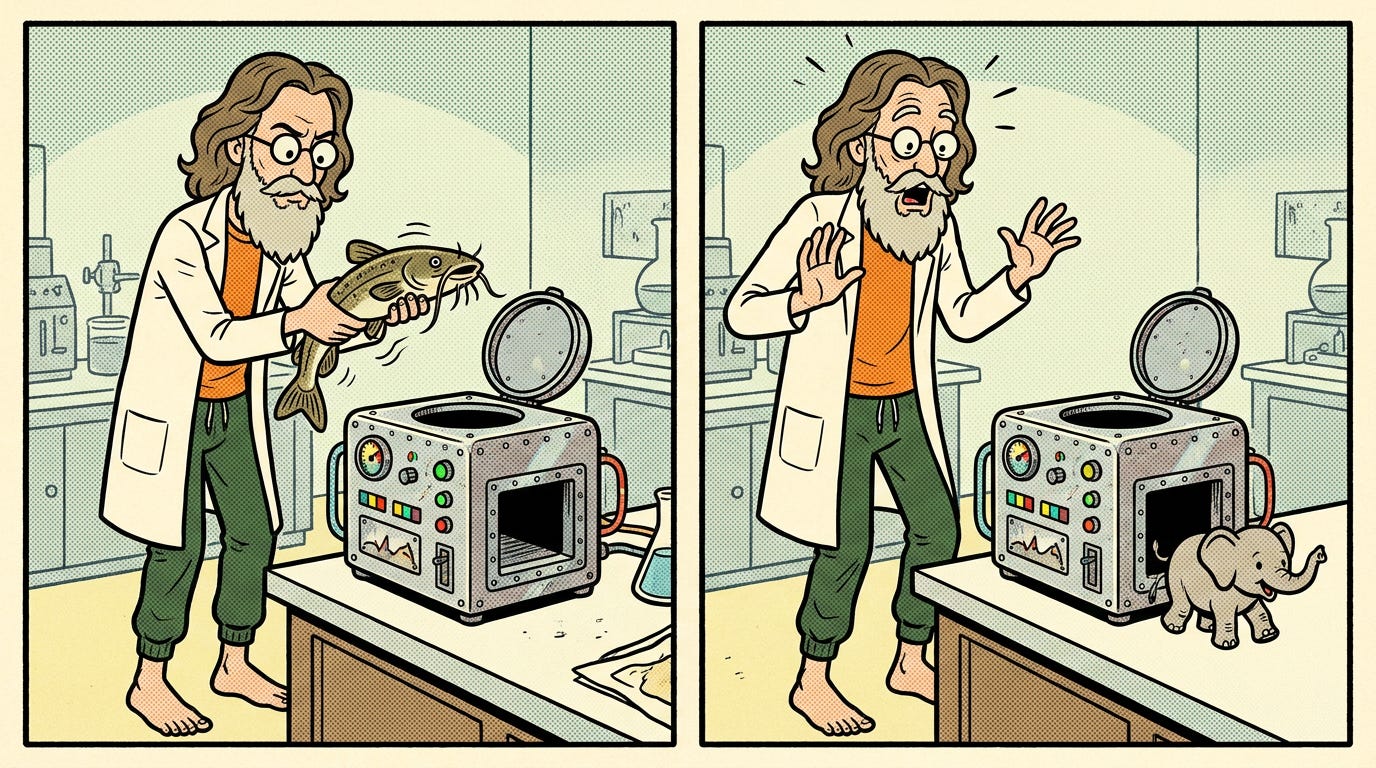
Both categories of glitch share this defining characteristic: they are uncontrolled. They do not produce output that is more structured than their input. A glitch puts in a fish and gives you back a damaged fish, or no fish at all. It does not give you an elephant.
The Bexar County Data
The idea that the Bexar anomalies are in any way related to a glitch does not match the data. It sounds plausible in isolation, the way almost anything does before you compare it to evidence. A plausible idea remains plausible only as long as it has no opportunity for comparison to evidence. When that opportunity is available and the idea is inconsistent with the data, it ceases to be plausible.
That is the case here. The Times reported that the FBI concluded the anomalies were most likely caused by a “drag-and-drop error” as county officials moved data into an Excel spreadsheet. Let me explain why that explanation is impossible.
What the File Actually Contains
The Bexar County Republican primary early voting check-in file for February 18, 2026 contains 8,923 records. Of those, 4,110 records bear State Identification numbers with fractional components — numbers like 1,256,119,003.57755. Texas State Voter Identification numbers are administrative integers. A fractional component is not a data entry error, a rounding artifact, or a migration residue. It is a value that cannot exist in a clean voter registration database. No legitimate Texas voter has a fractional State ID.
The 4,110 records correspond to 735 real registered voters, each of whom appears either 5 or 6 times in the fraudulent records — never 1, 2, 3, 4, 7, or any other number. This rigid structure — exclusively 5 or 6, with no exceptions across 735 parent voters — is already the first thing no glitch can produce. A glitch does not count. A glitch does not enforce a minimum or a maximum. A glitch does not know what a voter record is.
The Mathematical Proof
When all 4,110 fractional records are sorted in ascending order by State ID and the gap between consecutive records is calculated, something extraordinary emerges. The first record in the sequence belongs to Mr. RA, with State ID 1,253,115,467.79993. The last belongs to Mr. JB, with State ID 1,343,862,000.96332. The span between them is:
1,343,862,000.96332 − 1,253,115,467.79993 = 90,746,533.16339
Dividing this span by the gap value between consecutive records:
90,746,533.16339 ÷ 22,084.82189 = 4,109.0000
The result is exactly 4,109 — a perfect integer with zero remainder. This is mathematical proof that the 4,110 records form a single, deliberately constructed, uniformly spaced sequence. A randomly generated or accidentally corrupted sequence cannot produce this result. Only deliberate computation does.
A drag-and-drop error in Excel does not produce a perfect integer quotient across 4,110 records spanning a range of 90 million ID numbers. It does not produce a universal constant gap value. It does not enforce a structured spacing relationship across the entire dataset. A drag-and-drop error produces duplicated rows — literal copies of what was dragged. It does not generate new fractional ID numbers that did not previously exist anywhere in the dataset.
The Algebraic Structure
The five core numbers in this dataset — 735 anchor names, 4,110 synthetic records, a gap of 22,084.82189, a span of 90,746,533.16339, and the 300/435 clone-group split — are not independent observations. They form a single interlocking algebraic system in which every value determines every other.
Given 735 anchor names and a target of 4,110 total synthetic records, with each anchor receiving either exactly 5 or exactly 6 copies and no remainder, the split must be precisely 300 names with 5 copies and 435 names with 6 copies. There is no other combination that satisfies both constraints simultaneously. The system has exactly one solution. This is not a statistical finding. It is arithmetic.
A glitch does not solve simultaneous equations. A glitch does not enforce a uniquely determined integer split across 735 independently selected voter identities. A glitch does not produce a dataset in which every value is determined by every other through a coherent algebraic system.
Why Mr. RA and Mr. JB
A natural question arises: why does the sequence begin with Mr. RA and end with Mr. JB? The answer reveals a further level of design.
When the 4,110 fractional records are sorted by State ID in ascending order, they cycle through the 735 anchor voters in strict alphabetical order by last name. Mr. RA receives the minimum fractional State ID because his surname sorts first among all 735 anchor last names.
The algorithm makes five complete passes through all 735 anchor names in alphabetical order, then begins a sixth pass that terminates after exactly 435 names. The 435th name in the alphabetical sort is Mr. JB. He therefore receives the final synthetic record. Mrs. FB — whose last name is identical and who sits at alphabetical position 436, one place past the cutoff — receives only 5 copies, not 6. The cutoff falls precisely between two members of the same household.
Position 435 is not arbitrary. It is the unique algebraic solution to the clone distribution constraint: with 735 anchors and 4,110 total synthetic records, the only integer split where each anchor receives exactly 5 or 6 clones is 300 anchors receiving 5 and 435 receiving 6. The chain of determination is: algebraic constraint → position 435 → JB as endpoint. Two endpoints selected by the same mechanism — last-name alphabetical sort — each determined by a different mathematical requirement. This is evidence of one author, one algorithm, one deliberate act.
A drag-and-drop error does not sort voter names alphabetically. A drag-and-drop error does not apply the solution to a constraint system as a stopping condition. A drag-and-drop error does not know where the 435th name in a sorted list is.
The Dead Zone
All 4,110 synthetic State IDs were placed inside a gap in the Texas statewide voter ID space. The Texas statewide voter roll contains 18.3 million records. Within that range sits a void: the last legitimate voter in the entire state before the gap holds ID 1,222,380,331. The next legitimate voter after the gap holds ID 2,000,050,898. Between those two numbers — a span of approximately 777.7 million consecutive ID numbers — there is not one registered Texas voter anywhere in the state. The 4,110 fraudulent records were placed entirely within this void.
Finding that void required querying the complete Texas statewide voter database across all 254 counties. A county clerk does not have that data. A precinct chair does not have that data. A drag-and-drop error in Excel does not query 18.3 million voter records across 254 counties, identify a 778-million-number gap in the statewide ID space, and then place 4,110 new records inside it while avoiding any collision with a real voter’s ID. The reconnaissance required for this placement was not county-level. It was state-level.
The Floating-Point Fingerprint
Analysis of the 4,109 individual gap values at full 15-digit decimal precision reveals a deterministic four-value cycle. The four values form two micro-pairs consistent with IEEE 754 double-precision floating-point arithmetic, in which the same division operation executed in forward versus reverse order produces conjugate rounding residuals. These four values are organized into palindromic seven-element blocks that repeat throughout the full gap sequence, because the algorithm processes the anchor list in alternating forward and reverse passes — each complete traversal producing a gap sub-sequence that is the mirror image of the preceding traversal.
Ten boundary anomalies occur at regular intervals corresponding exactly to the 735-record cycle boundaries — independently confirming the anchor group size of 735 without reference to any other data field. This palindromic gap structure cannot arise from manual data entry, database migration, display formatting, software misconfiguration, or random corruption. It is the deterministic output of a specific floating-point loop executing in a compiled language. The algorithm was not a formula applied to a spreadsheet. It was purpose-written code.
The Address Patterns
The synthetic records also reveal how the algorithm handled addresses. For anchor voters whose real address was unique among the 735, each successive synthetic copy received an address with the house number incremented by exactly one — +1, +2, +3, and so on. For anchors whose real address was shared with at least one other anchor, all synthetic copies received an exact duplicate of the real address. This bifurcation reflects a household-detection heuristic designed to avoid generating two synthetic records with identical fabricated addresses.
The algorithm also exhibits two identifiable failure modes in this heuristic — one involving name suffixes like “JR” being parsed as last names, causing misidentification of household members; and one involving an off-by-one error at adjacent alphabetical positions. These bugs are as forensically informative as the correct behavior. A spreadsheet formula or manual process does not have implementation defects of this character. Broken code is the most traceable code.
The Temporal Constraint
Two independent lines of evidence establish that the injection could not have been executed during the voting day and required the completed check-in list.
First, alphabetical proportion. A/B/C surnames represent approximately 18.7% of the organic February 17 check-in population. The 735 anchor names constitute approximately 20% of the 4,845 total February 18 records — consistent with the natural A/B/C proportion of a complete alphabetical voter list. This proportion can only arise if the algorithm operated on the full day’s check-in list after voting concluded. No partial list accumulated during the day could produce the correct proportion.
Second, the spacing gap itself was derived from the span between the first and last fractional State IDs, whose positions in the sequence are determined by the alphabetical sort of the complete 735-name anchor set. The algorithm required the complete voter list in hand before a single synthetic record could be generated. The injection was therefore executed after polls closed on February 18, by an actor with back-end access to the data.
Back to the Glitch
A hallmark of glitches is that they are random. The Bexar anomalies are highly structured, mathematically complex, and affect the data in a deterministic way. This is the opposite of what a glitch does.
To summarize why each category of glitch explanation fails:
A hardware failure cannot produce a universal constant gap value across 4,109 consecutive pairs. It damages data at the point of failure, randomly and non-selectively. It does not generate 4,110 new records that did not previously exist.
A drag-and-drop error in Excel produces literal duplicates of whatever was dragged. It does not generate new fractional ID numbers. It does not enforce a structured spacing relationship. It does not solve a two-equation integer system. It does not sort records alphabetically and apply a mathematically determined stopping condition.
A software glitch of the kind I personally experienced on X — where raw training data leaked through a broken inference pipeline — produces output that appears to have structure inherited from its source material, but it does not produce anything purposeful. It removes a layer of processing. It does not add one.
None of these explanations accounts for state-level database reconnaissance. None accounts for the palindromic floating-point gap structure. None accounts for the household-detection heuristic and its specific failure modes. None accounts for the algebraic consistency between every parameter in the dataset. No single rebuttal addresses all of these axes simultaneously — because no single failure mode produces all of them.
The fish went in. What came out was not a fish. It was not random debris. It was a precisely engineered elephant — the same elephant, measured to fifteen decimal places, that also turned up in Utah.
P.S. The Times attributed what appears to be my analysis to Dr. Walter Daugherity. Dr. Daugherity was involved in this work, and I value his collaboration. However, the Substack the Times appears to have been reading is mine, not his. Dr. Daugherity does not have a Substack. Much of what the Times attributed to him was either material we both covered or material that only I covered. I have noted this for the record.
As much as you might want the Times to accurately report, they're on the side of the narrative that promotes glitches, hand waving and "nothing to see here". I'm guessing they've seen your analysis (otherwise, why is Bexar county voter rolls even on their radar?) and they're trying to shape the narrative.
FBI "glitches":
1) The woman with hair dyed and bleached blond is blond even though she is a brunette.
2) The man with a diploma hanging on the wall with his name and the following “Massachusetts Institute of Technology upon the recommendation of the faculty hereby confers on this man the degree of Doctor of Philosophy in recognition of scientific attainments and the ability to carry on original research as demonstrated by a thesis in the field of (name) given this day under the Seal of the Institute at Cambridge in the Commonwealth of Massachusetts.” is a doctor of philosophy even though the document is a counterfeit.
3) A voter roll with "glitches" is still a voter roll.
Average intelligence person's "common sense":
1) Dying your brunette hair blond does not make you genetically a blond. You have to keep bleaching and dying it to have blond hair.
2) The man with the counterfeit MIT diploma is a con artist.
3) A list of names attached to government generated ID numbers with fake people on it shouldn't be used for anything.