

All state varsity clone league

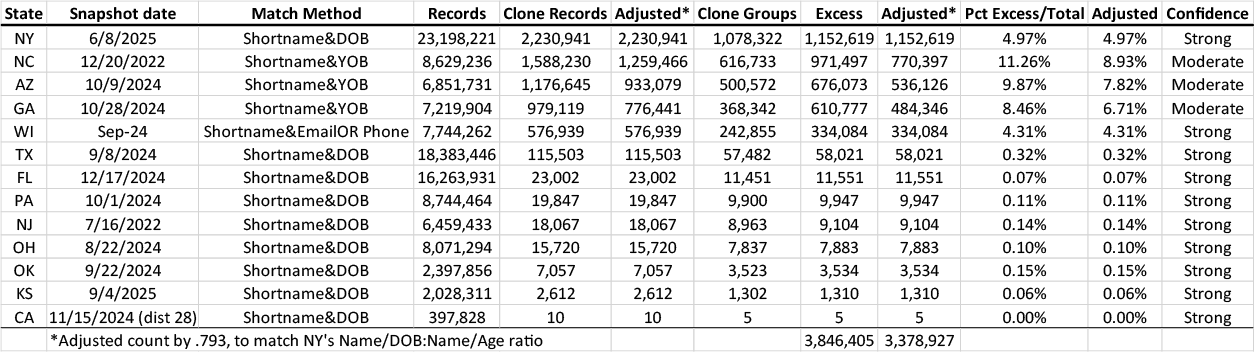
It remains perplexing to me that anyone would try to defend our electronic voting infrastructure. It would be difficult to make voting any less transparent, or any more conducive to fraud.
The mere fact that our votes are electronically tabulated by machines running code written by foreigners means that foreigners may as well be counting our ballots. Would anyone here want to have their ballots counted by Canadian officials who hate President Trump and other conservatives? Or worse, Venezuelans who may as well be at war with us?
It wouldn’t be quite as bad if we knew what the software looked like and how the counting is accomplished, but we don’t. It’s “proprietary”, so we aren’t allowed to look, let alone know, what is going on. I remember the old days when tallies were kep on a chalkboard and anyone who was interested could look and see what was going on. That, or when we bought a computer, we owned it and could inspect it all day long if we felt like it.
Of course, that’s just on the counting end of the equation. On the other, we have the voter rolls. We can’t vote unless registered, and can’t register unless qualified. This is supposed to be checked at the registration stage, but clearly isn’t, or there wouldn’t be as many cloned records as there are, nor individuals with as many as 23 excess registrations each, or 24 total for completely fictitious voters.
The mere fact that there are millions of clones across the 12 states I’ve looked at (and likely many more) tells me that no election official can with any confidence tell us how many unique individuals voted, or verify that each ballot corresponds to an eligible voter.
The rolls are supposed to capture that information, but the mere presence of clones make it impossible to know for certain whether any given vote was cast by a real person or an illegally cloned record in that person’s name. My guess is that most votes were cast by the people our rolls tell us actually voted, but “most” isn’t good enough when victory margins only require a small fraction of the vote to change the outcome.
Add to this the fact that no given snapshot of any of the databases agrees with any other snapshot for the same database. On top of that, I haven’t seen any that agree with the certified count either. Maybe there are some states that do. I haven’t seen multiple snapshots of every state, nor compared the certified total to every state’s “voters who voted” statistic.
The ones I have checked, however, all of them, are out of sync with the certified results. It is a very basic question to ask, “how many people voted”? but who can answer that question?
You can’t say X people voted based on the number of ballots counted. For all we know, some of those ballots are fraudulent. That’s why we keep track of who voted in the voter rolls. If the rolls can’t reliably answer that question, then can any election official answer it either?
Gemini 3 is used to power Google’s AI Mode.
Unlike the Google search engine itself, it appears to have eliminated the embedded bias when you query about election fraud. I fed it your quote:
“The quote, "'The mere fact that our votes are electronically tabulated by machines running code written by foreigners means that foreigners may as well be counting our ballots'," is attributed to Dr. Andrew Paquette, a researcher who applies pattern recognition techniques to analyze anomalies in electoral data systems.
Dr. Paquette, who has a background in digital visual analysis from the computer graphics industry (including work at Epic Games, Universal Studios, and Sony), is known for his work in identifying potential issues with voter ID number assignment algorithms and other electoral data systems, as noted in the Journal of Information Warfare.
The statement reflects his concern regarding potential security vulnerabilities and the lack of transparency in electronic voting systems when source code is not fully scrutinized or is developed by non-domestic entities.
His research focuses on data anomalies and the security of election processes, often advocating for greater scrutiny of the software and systems used in elections. The quote highlights a common concern among election integrity advocates about the reliance on proprietary, unauditable software, especially if the origin of that software is foreign.”
"Add to this the fact that no given snapshot of any of the databases agrees with any other snapshot for the same database. On top of that, I haven’t seen any that agree with the certified count either."
This. The current level of traceability and auditability is just horrible. Criminal, even.